
We have been married for 29 years. We have raised two daughters, Morgan and Clarke, in Raleigh, North Carolina. We have spent nearly three decades making deliberate choices about what our girls saw, read, held in their hands, and believed about themselves. We bought them dolls that looked like them. We found children's books where the characters shared their skin. We talked at the dinner table about who they were and where they came from. We did all of this not because we had some program or grand strategy. We did it because we understood something that every Black parent understands deep in their bones: if you do not put the mirror in front of your child, the world will hand them someone else's reflection.
We are writing this letter to tell you why we built Letters From Another Time. Not the business version of the answer, not the pitch deck version. The real version. The one that begins on a Saturday afternoon when Cynthia was looking at what was available in the children's subscription market and turned to Antoine and said: why is there nothing here that looks like us?
There was no short answer to that question. But it planted something.
The gap that started this
Antoine spent 27 years in enterprise technology. AT&T. Cisco. MetLife. Discover Financial. Eaton. He has built things at scale. He knows how to see a problem, design a solution, and execute it. But he will tell you that nothing in his professional career prepared him for the particular weight of what he found when he started researching the state of Black children's literacy in this country.
Here is what the data says, and we are sharing it because we think every parent deserves to know it.
of Black fourth graders in the United States scored below reading proficiency in 2024.
Annie E. Casey Foundation / NAEP, 2024of children's books feature Black characters, despite Black children making up 14% of the U.S. child population.
Cooperative Children's Book Center, 2022White authors and illustrators are represented in school curricula 6.8 times more than Black authors and illustrators.
The Education Trust, 2023In a study of 300 grade school books, nearly half of all people of color depicted were shown as one-dimensional, negatively, or without agency, even in books meant to celebrate diversity.
The Education Trust, 2023Black character representation in children's bestsellers declined between 2020 and 2022, reversing gains made after the racial justice movement.
WordsRated, 2022We are not sharing these numbers to make you angry, though anger would be appropriate. We are sharing them because they describe the world our children are growing up in. A world where a Black child can go to school every day, sit in front of books designed to teach them to love reading, and see themselves almost nowhere in those pages. Or worse, see themselves reduced to one-dimensional versions of what they actually are.
We looked at that gap and we could not look away.
I looked at what was available for Black children in the subscription market and I saw a gap so wide you could lose a generation in it.
Our daughters changed everything
Antoine has a book on Amazon. It is called The Epic Journeys of Morgan and Clarke: Running with Harriet. The lead characters are named after our daughters. They are the heroes of the story. When Antoine wrote that book, it was not a business calculation. It was a father who wanted to give his girls the experience of seeing themselves at the center of an adventure. Of being the main characters. Of mattering.
That book was the seed. Letters From Another Time is what grew from it.
Cynthia has spent her entire adult life thinking about identity. Not academically, personally. As a Black woman who has raised Black daughters in a country that does not always reflect their worth back to them. She understood before we ever started building this product what was missing and why it mattered.
Identity has always been such an important concept in our home. We made sure our daughters knew who they were and that they were beautiful.
Those are not marketing words. That is what we talked about at the kitchen table when the girls were young. That is the conviction this entire company is built on. The product you are holding in your hand right now, or about to hold, is the answer to a question we have been living with for decades: what does it look like to give a Black child a truly unobstructed view of their own history, told through the voice of someone who looks like them?
We think it looks like a letter. A real one. Sealed. Addressed to your child by name. From a child who lived it.
What Letters From Another Time actually is
Once a month, your child receives a physical letter in the mail. Not digital. Not an email. Not a notification. A real envelope, with their name on it, that they pick up, turn over in their hands, and open themselves.
Inside that envelope is one letter, written by a fictional Black child living in Harlem, New York, in 1926, the height of the Harlem Renaissance. One of the most dazzling, defiant, extraordinary chapters in the entire history of Black American life. The letter is written by hand in period voice, as if time has folded and this child reached forward to find yours.
Tucked into the same envelope are historically appropriate artifacts, items a child of that era might have saved, shared, or treasured. A pressed flower. A newspaper clipping. A small piece of the world Marcus or Cora actually lived in. Something to hold. Something to keep.
Also inside is a parent guide, a tool designed to turn what your child just read into a real conversation. Questions to ask. Context to share. History to explore together. The letter opens a door, and the parent guide helps you walk through it side by side.
One envelope. One letter. Real artifacts. A guide for you. Delivered to your door every month.
Marcus James Washington
Age 11 · written for readers ages 7 to 9
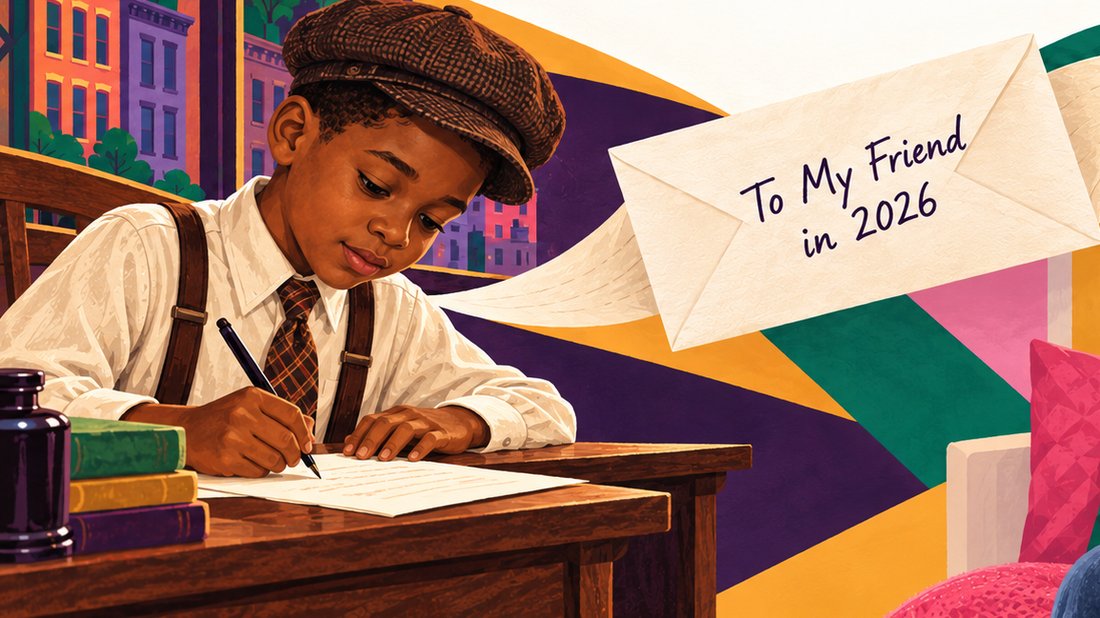
Marcus is the son of a Cotton Club jazz trumpeter. He is eleven years old, loud in the best possible way, full of Harlem energy, and absolutely certain that he is going to become a pilot someday. In 1926, when the sky itself was segregated and no commercial airline would hire a Black man. His father Calvin, who fought his way to a Cotton Club marquee, did not teach his son that the sky has limits. So Marcus does not believe in them.
His letters carry the particular electricity of a child who sees magic in jazz, in neighbors, in the Great Migration stories his grandmother Ida carries north like sacred cargo. A child who announces things rather than wonders them.
Cora Elaine Beaumont
Age 10 · written for readers ages 10 to 13
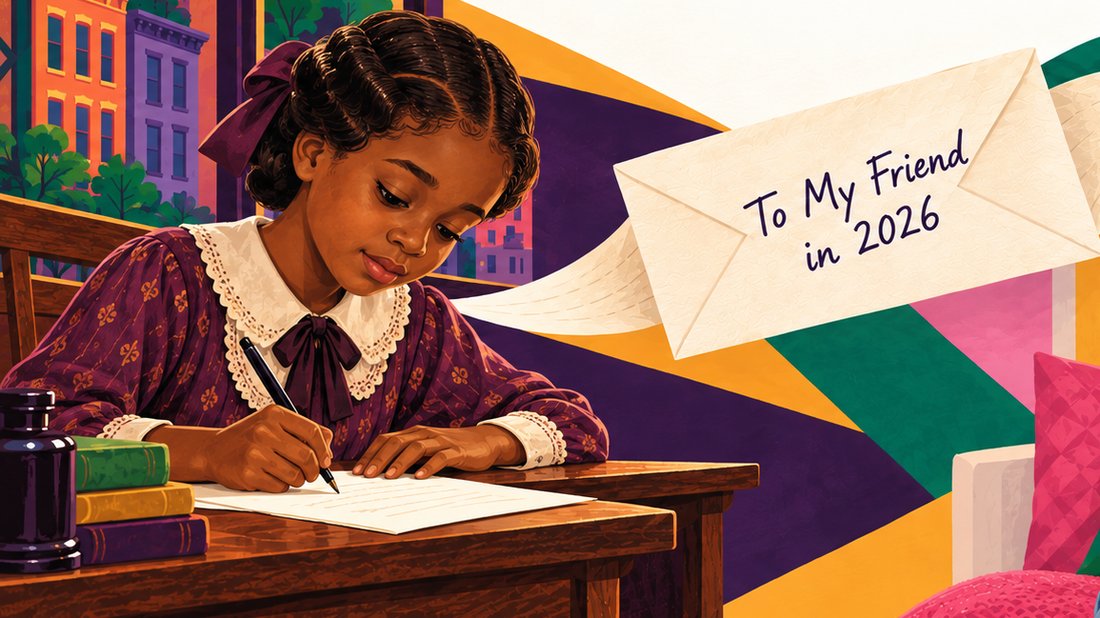
Cora is the daughter of a Pullman porter. She is ten years old, inward, observational, a writer before she knows she is a writer. She presses flowers. She notices what other people walk past. She writes four drafts before she finds her first sentence and then says something that takes your breath away.
Her letters carry the particular beauty of a child who feels everything at a depth that surprises even her. A girl whose father James travels the country and brings the world home in stories. A girl whose mother Virginia is a seamstress whose hands hold the neighborhood together.
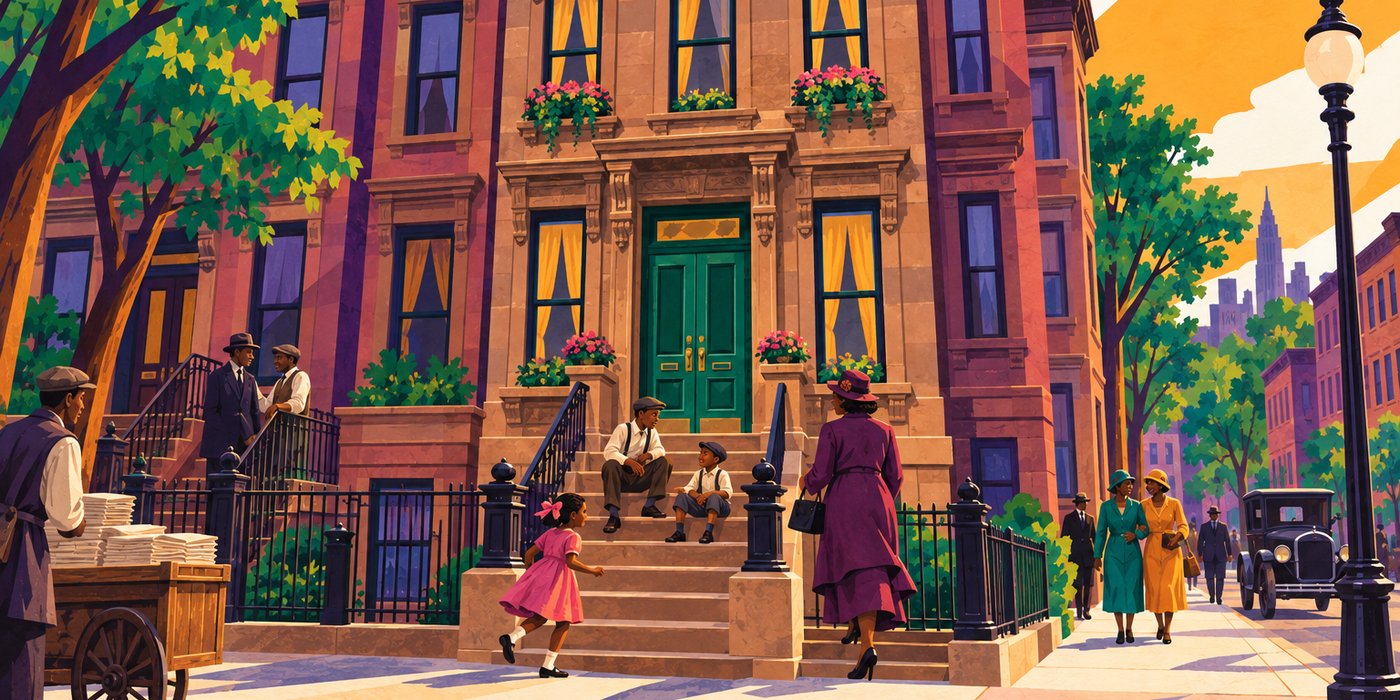
Marcus and his family live on the second floor of a three-story brownstone on 133rd Street. Cora and her family live on the third, high enough to catch a breeze off the rooftops. And on the first floor, closest to the stoop and the street and all the noise of the block, live the Williams family: Raymond, Ruthie, and their daughters Josephine and Agnes. Three families. One brownstone. One stoop where Harlem passes by every single day. A child reading these letters is not just meeting one child. They are stepping into a whole living world.
And because each letter is addressed to your child by name, because Marcus or Cora is writing specifically to them, something happens that no textbook can manufacture. Your child is not reading about history. They are corresponding with it.
Why physical mail, and not digital
We get asked this. A lot.
The answer is simple, and it is backed by decades of research on how children engage with reading. When a child receives something physical, something with weight, with texture, with a seal they break themselves, their brain processes it differently than a screen. They slow down. They read it again. They save it. Families who have seen these letters report their children reading them multiple times, carrying them to school, putting them somewhere special.
A screen can be swiped away in two seconds. A letter becomes an object. An object becomes a memory. A memory becomes identity.
There is no algorithm between your child and Marcus. No autoplay pushing them toward something else the moment the letter is done. Just the letter, the artifacts inside, and the world that a child from 1926 placed in their hands.
We chose the mail deliberately, stubbornly, and we have never once second-guessed it.
The name on our company means everything
We named our company Sankofa Innovations LLC. Sankofa is an Akan word, and a symbol, that means go back and get it. It represents the wisdom of learning from the past in order to build the future. It is often depicted as a bird flying forward while looking backward.
That is what this product does. It asks children to turn around and look, really look, at what was built before them. Not just the suffering. Not just the survival. The beauty. The creativity. The extraordinary ordinariness of Black children in 1926 who had inner lives as rich and complex as any child alive today.
Our children are not the descendants only of people who endured. They are the descendants of people who built, who dreamed, who danced, who played stickball in the street and pressed flowers between pages and stayed up too late because Harlem never really went to sleep. Letters From Another Time puts that world in an envelope and mails it to your door.
The child who knows where they come from is the child who knows where they are going.
What comes after Season One
Season One is set in the Harlem Renaissance: twelve months, twelve letters, a complete narrative arc for Marcus and Cora that brings 1926 Harlem to life one envelope at a time. We are beginning with 50 founding households across the country, families who believe in what we are building and want to be part of it from the very first envelope.
But the Harlem Renaissance is only the beginning.
When Season One closes, Letters From Another Time will not close with it. What we have built is not a single story. It is a framework, a living platform for delivering Black history to Black children through the most powerful lens we know: the eyes of a child who was actually there.
Every season that follows will be set in a different historical era. Each era will introduce new child characters, boys and girls with distinct voices, distinct families, distinct dreams, who will write letters from inside a moment in history that most of our children will never encounter in a classroom. Not as dates. Not as names to memorize. As life. As friendship. As the feeling of waking up in a particular year, in a particular place, and being a Black child in America with a whole world in front of you.
Think about what that means. A child who grows up with Letters From Another Time will not just know that the Civil Rights Movement happened. They will have received a letter from a child who walked those streets, who felt that particular fear and that particular fire, who described what it smelled like and what the singing sounded like and what their mother told them before they left the house that morning.
That is the vision. Not a subscription. A living archive. A generation of Black children who understand, not because they were taught it, but because they lived it through the mail, that their history is vast, and beautiful, and full of children just like them.
Each new season is a new door. We intend to open as many as our children need.
Black children are not just the descendants of people who survived. They are the descendants of people who built, created, dreamed, and celebrated, even when the world told them not to.
One last thing
We want to be direct about something.
We are not outsiders who identified a market and built a product for a community we studied. We are inside this community. We have raised children in it. We have felt the particular worry that every Black parent feels when they look at what their children are being handed and realize it is not enough. We have made the deliberate choices, the dolls, the books, the conversations, that Black parents make when the world is not doing its job.
Letters From Another Time is not a business that looks like us. It is a business that is us. Everything in it, Marcus's confidence, Cora's precision, the three families sharing one brownstone on 133rd Street, the Cotton Club, the Pullman porter, the pressed flowers, the fountain pen, comes from real research, real history, real love, and a real conviction that Black children deserve to open their mailbox and find something that says: you come from something magnificent. And so do you.
We hope you will join us. We hope your child will be the one who opens that first envelope. We hope they will read the letter twice, then fold it carefully and put it somewhere safe.
That moment is why we built this. That moment is everything.
With love and with purpose,
Antoine & Cynthia Medley
Co-founders, Letters From Another Time
Sankofa Innovations LLC · Raleigh, North Carolina